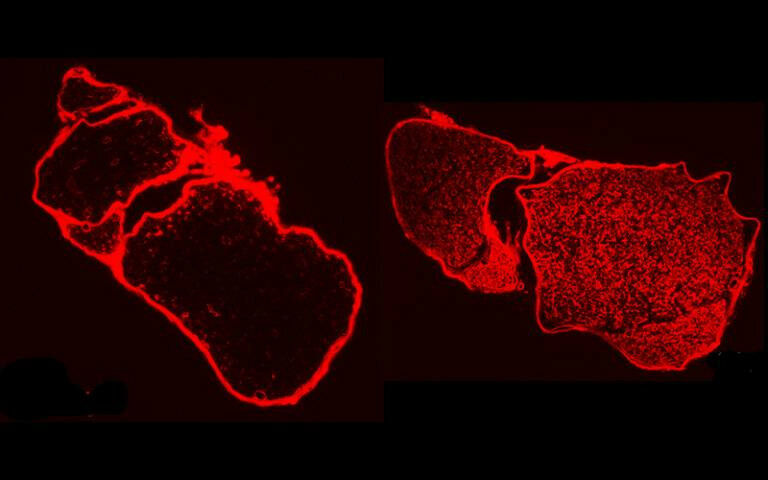
Peripheral nerves - Drugs (red spots) don’t get into peripheral nerves when the barrier is closed (left-side image) - only when the barrier is opened (right-side image). Image courtesy Prof Lloyd.
Peripheral nerves - Drugs (red spots) don't get into peripheral nerves when the barrier is closed ( left-side image ) - only when the barrier is opened ( right-side image ). Image courtesy Prof Lloyd. A UCL-led research team has opened and closed the blood-nerve barrier for the first time and used it to deliver drugs to target tissues. The Medical Research Council and Cancer Research UK-funded research, published in Developmental Cell , has the potential to both deliver tumour-killing drugs to the nervous system, and also prevent side effects from chemotherapy that result from damage to the peripheral nervous system. The blood-nerve barrier is less well understood than the related blood-brain barrier, which stop substances in the blood getting to the sensitive environments of the brain and peripheral nerves. They also pose a barrier for medications, so the latest study has been seeking to identify new ways to deliver drugs to the nervous system, without causing damage. Lead author Professor Alison Lloyd, director of the UCL Laboratory for Molecular Cell Biology, explained : "We've defined the structure and control of the blood-nerve barrier - the cell types that are involved, how they interact, how it can be regulated and why it's a barrier.
TO READ THIS ARTICLE, CREATE YOUR ACCOUNT
And extend your reading, free of charge and with no commitment.