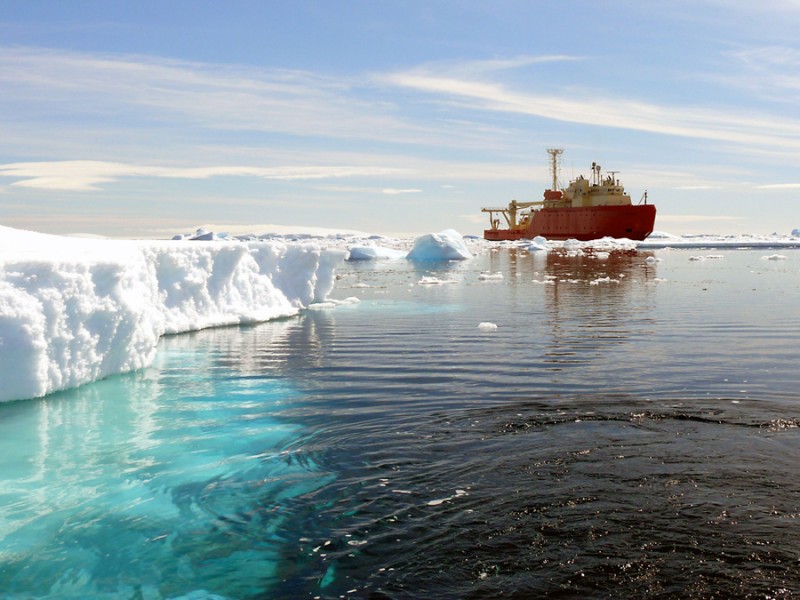
Oscar Schofield / Rutgers University A research ship in the dangerous waters off Antarctica. Robotic floats are a cheaper and safer way to collect measurements.
University of Washington - If historic explorer Ernest Shackleton were recruiting for the job, he might point out the bitter cold, long hours of complete darkness, danger and eventual "honor and recognition in event of success. This time the call is not for men to trek across Antarctica, but for robotic floats built at the University of Washington to brave the world's harshest ocean to help understand its role in the global climate. The Southern Ocean, or the seawater that encircles Antarctica, soaks up half of the carbon emitted by humans and is thought to have absorbed much of the planet's excess heat in recent decades. Yet, the inner workings - and global importance - of the waters that account for 30 percent of the world's ocean area remain relatively unknown to scientists, as observations are hindered by dangerous seas. The U.S. National Science Foundation this week announced a $21 million project to measure and model this region's role in the climate. The six-year Southern Ocean Carbon and Climate Observations and Modeling program is headquartered at Princeton University. The UW is one of 10 partner institutions.
TO READ THIS ARTICLE, CREATE YOUR ACCOUNT
And extend your reading, free of charge and with no commitment.