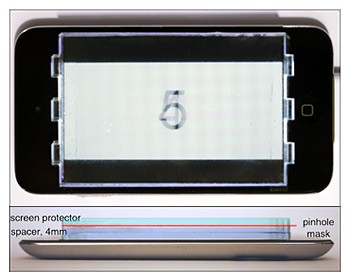
Researchers placed a printed pinhole array mask on top of an iPod touch as part of their prototype display. Shown above are top-down and side-view images of the setup. (Photo courtesy of Fu-Chung Huang)
The blurred image on the left shows how a farsighted person would see a computer screen without corrective lenses. In the middle is how that same person would perceive the picture using a prototype display that compensates for visual impairments. The picture on the right is a computer simulation of the best picture quality possible using the new prototype display. The images were taken by a DSLR camera set to simulate hyperopic vision. (Photo by Houang Stephane/flickr; modified by Fu-Chung Huang/UC Berkeley) What if computer screens had glasses instead of the people staring at the monitors? That concept is not too far afield from technology being developed by UC Berkeley computer and vision scientists. The researchers are developing computer algorithms to compensate for an individual's visual impairment, and creating vision-correcting displays that enable users to see text and images clearly without wearing eyeglasses or lenses. The technology could potentially help hundreds of millions of people who currently need corrective lenses to use their smartphones, tablets and computers.
TO READ THIS ARTICLE, CREATE YOUR ACCOUNT
And extend your reading, free of charge and with no commitment.