China’s Loess Plateau
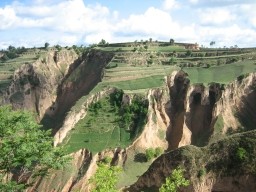
Temperatures in central China are 10 to 14 degrees Fahrenheit hotter today than they were 20,000 years ago, during the last ice age, UCLA researchers report — an increase two to four times greater than many scientists previously thought. The findings could help researchers develop more accurate models of past climate change and better predict such changes in the future. "Previously, we could only infer temperature on land through changes in climate archives like tree rings or pollen over time," said lead author Robert Eagle, a UCLA researcher in the department of Earth and space sciences. "This is the first time that temperature has been determined accurately on land at the time of the last ice age." To make their temperature measurements, the scientists used a technique known as clumped isotope thermometry, which detects subtle atomic differences in calcium carbonate, a compound commonly found in rocks, snail shells and wind-blown dust deposits known as loess. The method is the most accurate land-based temperature-determination tool available today. "We can now tell what temperatures were on land 20,000 years ago with more accuracy than was ever previously possible," said senior author Aradhna Tripati, a UCLA assistant professor in the department of Earth and space sciences and the department of atmospheric and oceanic sciences. Tripati and Eagle chose to study the Loess Plateau in central China, a 250,000-square-mile agricultural region some 500 miles southwest of Beijing, because of its wide expanses of loess, the silty sediments that give the area its name and which contain deposits from the last ice age.
TO READ THIS ARTICLE, CREATE YOUR ACCOUNT
And extend your reading, free of charge and with no commitment.