An
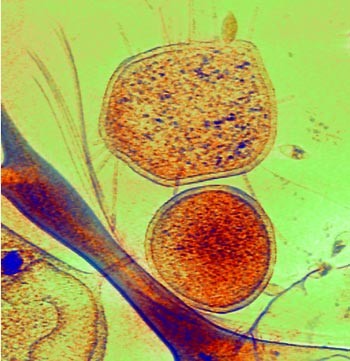
ARMAN cell (center, orange) is penetrated by a needle-like protrusion
from Thermoplasma (lower left), an Archaea that lives in the same
acidic pools as ARMAN. The much smaller, yellow lozenges are viruses
that also infect ARMAN cells. A probably dying
ARMAN cell (top) has grown to a diameter of about 1,000 nanometers - less
than one hundredth the width of a human hair.
Video (11 sec. Using a cryoelectron microscope, researchers focus at different depths to see how ARMAN and Thermoplasma are connected BERKELEY — In the depths of a former copper mine in Northern California dwell what may be the smallest, most stripped-down forms of life ever discovered. The microbes — members of the domain of one-celled creatures called Archaea — are smaller than other known microorganisms, rivaled in size only by a microbe that can survive solely as a parasite attached to the outside of other cells. Their genomes, reconstructed by a group at the University of California, Berkeley, are among the smallest ever reported. An ARMAN cell (center, orange) is penetrated by a needle-like protrusion from Thermoplasma (lower left), an Archaea that lives in the same acidic pools as ARMAN. The much smaller, yellow lozenges are viruses that also infect ARMAN cells. A probably dying ARMAN cell (top) has grown to a diameter of about 1,000 nanometers - less than one hundredth the width of a human hair.
TO READ THIS ARTICLE, CREATE YOUR ACCOUNT
And extend your reading, free of charge and with no commitment.