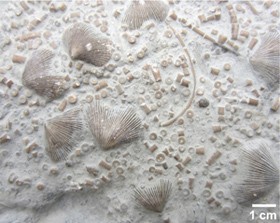
Bedding surfaces covered in marine invertebrate fossils from the Late Ordovician (Ellis Bay Formation, Anticosti Island, Québec, Canada). Anticosti Island preserves one of the most fossiliferous and stratigraphically complete records through the Late Ordovician Mass Extinction in North America.
The second-largest mass extinction in Earth's history coincided with a short but intense ice age during which enormous glaciers grew and sea levels dropped. Although it has long been agreed that the so-called Late Ordovician mass extinction—which occurred about 450 million years ago—was related to climate change, exactly how the climate change produced the extinction has not been known. Now, a team led by scientists at the California Institute of Technology (Caltech) has created a framework for weighing the factors that might have led to mass extinction and has used that framework to determine that the majority of extinctions were caused by habitat loss due to falling sea levels and cooling of the tropical oceans. The work—performed by scientists at Caltech and the University of Wisconsin, Madison—is described in a paper in the early edition of the Proceedings of the National Academy of Sciences . The researchers combined information from two separate databases to overlay fossil occurrences on the sedimentary rock record of North America around the time of the extinction, an event that wiped out about 75 percent of marine species alive then. At that time, North America was an island continent geologists call Laurentia, located in the tropics. Comparing the groups of species, or genera, that went extinct during the event with those that survived, the researchers were able to figure out the relative importance of several variables in dictating whether a genus went extinct during a 50-million-year interval around the mass extinction.
TO READ THIS ARTICLE, CREATE YOUR ACCOUNT
And extend your reading, free of charge and with no commitment.