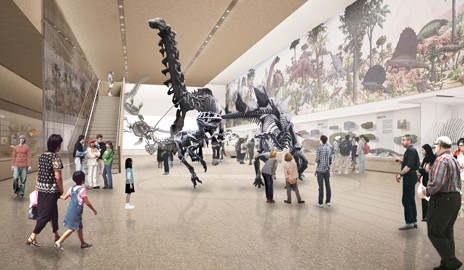
Newly mounted skeletons of Allosaurus and Stegosaurus will greet visitors as they enter the hall, while a new balcony will provide a dinosaur's-eye view of the Peabody's famous Apatosaurus and "The Age of Reptiles" mural.
Since humans first stumbled across mysterious dinosaur bones protruding from the earth, the fascination with these gigantic creatures has captivated the imagination. Yale's Peabody Museum of Natural History - which houses discoveries by one of the earliest dinosaur bone hunters, O.C. Marsh - is raising funds to commemorate its 150th anniversary with a $30 million renovation project that will transform its renowned Great Hall of Dinosaurs and adjacent Mammal Hall to reflect advances in the study of the history of life on our planet. "One of the museum's major aspirations is to demonstrate how new scientific evidence can lead to innovative interpretations," according to Derek E.G. Briggs, director of the Peabody. Briggs also noted that the collections are critical to teaching the history of life, evolution, and environmental change to Yale students, scholars, researchers, and the greater New Haven community. The Great Hall of Dinosaurs, originally constructed in the 1920s, is home to such iconic fossils as the Apatosaurus , familiarly known as Brontosaurus , discovered by Marsh, and the famous mural " The Age of Reptiles ," painted by Yale alumnus Rudolph F. Zallinger in the 1940s. For this magnificent achievement he received a Pulitzer Award for Painting in 1949. During the renovation, which will begin when funding is in place, the intrusive steel supports used to mount the dinosaurs in the 1930s will be removed, and the dinosaurs themselves will be disassembled, conserved, and remounted using modern techniques in dynamic poses that more accurately reflect current knowledge about how they lived.
TO READ THIS ARTICLE, CREATE YOUR ACCOUNT
And extend your reading, free of charge and with no commitment.