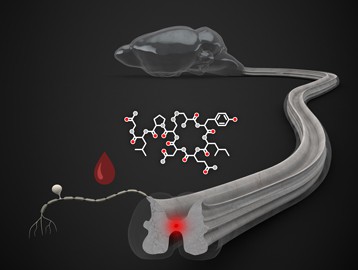
 © Thomas Splettstoesser - class="ImageLegende">30 small neurons in the hypothalamus have an analgesic effect: they trigger the release of ocytocin both in the deep layers of the spinal cord thanks to their long axons and in the bloodstream in order to inhibit the neurons that are sensitive to pain stimuli.
These two mechanisms are represented, respectively, by the red dot in the spinal cord and by the drop of blood.
© Thomas Splettstoesser - class="ImageLegende">30 small neurons in the hypothalamus have an analgesic effect: they trigger the release of ocytocin both in the deep layers of the spinal cord thanks to their long axons and in the bloodstream in order to inhibit the neurons that are sensitive to pain stimuli.
These two mechanisms are represented, respectively, by the red dot in the spinal cord and by the drop of blood.
Oxytocin plays a crucial role in modulating the response to pain, but until now the process leading to its release was unknown. An international team
1, coordinated by Alexandre Charlet, at the CNRS Institut des Neurosciences Cellulaires et Intégratives in Strasbourg (France) and Valery Grinevich from the DKFZ
2 in Germany, has just identified a new pain control center situated in the hypothalamus. It comprises some thirty neurons that are wholly responsible for coordinating the release of oxytocin into the blood and spinal cord, thus reducing painful sensations. These findings, which open new perspectives in the treatment of pathological pain, are detailed in an article published on 3 March 2016 in Neuron . That hammer blow on the fingers of the weekend DIY enthusiast must have hurt. But it would have been worse if oxytocin, a peptide synthesized by a region in the brain called the hypothalamus, had not intervened very rapidly in the cerebral processes modulating the pain response. From contractions of the uterus during delivery to the release of breast milk after birth, and not forgetting its involvement in regulating social interactions, anxiety or pain, oxytocin is an essential, but currently somewhat mysterious, messenger.
TO READ THIS ARTICLE, CREATE YOUR ACCOUNT
And extend your reading, free of charge and with no commitment.
Your Benefits
- Access to all content
- Receive newsmails for news and jobs
- Post ads