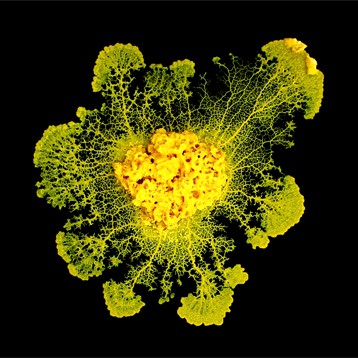
 © Audrey Dussutour (CNRS) The slime mold Physarum polycephalum (diameter: around 10 centimeters), made up of a single cell, was here cultivated in the laboratory on agar gel.
For the first time, scientists have demonstrated that an organism devoid of a nervous system is capable of learning. A team from the Centre de Recherches sur la Cognition Animale (CNRS/Université Toulouse III – Paul Sabatier) has succeeded in showing that a single-celled organism, the protist Physarum polycephalum, is capable of a type of learning called habituation. This discovery throws light on the origins of learning ability during evolution, even before the appearance of a nervous system and brain. It may also raise questions as to the learning capacities of other extremely simple organisms such as viruses and bacteria. These findings are published in the Proceedings of the Royal Society B on 27 April 2016. An ability to learn, and memory are key elements in the animal world. Learning from experiences and adapting behavior accordingly are vital for an animal living in a fluctuating and potentially dangerous environment.
TO READ THIS ARTICLE, CREATE YOUR ACCOUNT
And extend your reading, free of charge and with no commitment.
Your Benefits
- Access to all content
- Receive newsmails for news and jobs
- Post ads