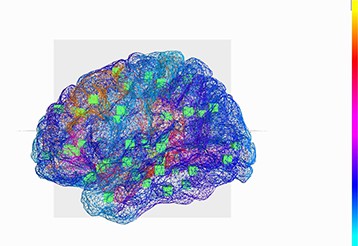
 © INS UMR1106 INSERM/AMU. The Virtual Brain: reconstruction of brain regions and where they are connected. The green cubes indicate the center of brain regions that are connected.
Researchers at CNRS, INSERM, Aix-Marseille University and AP-HM have just created a virtual brain that can reconstitute the brain of a person affected by epilepsy for the first time. From this work we understand better how the disease works and can also better prepare for surgery. These results are published in Neuroimage, on July 28, 2016. Worldwide, one percent of the population suffers from epilepsy. The disease affects individuals differently, so personalized diagnosis and treatment are important. Currently we have few ways to understand the pathology's mechanisms of action, and mainly use visual interpretation of an MRI and electroencephalogram. This is especially difficult because 50% of patients do not present anomalies visible in MRI, so the cause of their epilepsy is unknown.
TO READ THIS ARTICLE, CREATE YOUR ACCOUNT
And extend your reading, free of charge and with no commitment.
Your Benefits
- Access to all content
- Receive newsmails for news and jobs
- Post ads