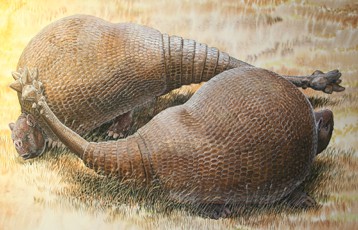
Before the last ice age, South America had an impressive array of megafauna including the megatherium, a sloth the size of an elephant, and a wide variety of glyptodonts, a group of imposing armored mammals. Glyptodonts have been traditionally considered to represent a phylogenetically distinct group close to the cingulates (armadillos). However, their exact affinities have remained an enigma until now. A research group led by the Institut des sciences de l'évolution de Montpellier (CNRS / Université de Montpellier / IRD / EPHE), the McMaster Ancient DNA Center in Canada
1, and also involving the Centre de recherche sur la paléobiodiversité et les paléoenvironnements in France (CNRS / MNHN Muséum national d'Histoire naturelle / UPMC) have answered this question by sequencing the whole mitochondrial genome of a 12,000-year-old specimen. The researchers managed to show that the glyptodonts are an extinct lineage of cingulates that experienced a spectacular increase in size following their appearance 35 million years ago. This research is published on 22nd February 2016 in the journal Current Biology . Glyptodonts are classified in the Xenarthra superorder, together with armadillos, sloths and anteaters.
TO READ THIS ARTICLE, CREATE YOUR ACCOUNT
And extend your reading, free of charge and with no commitment.
Your Benefits
- Access to all content
- Receive newsmails for news and jobs
- Post ads


