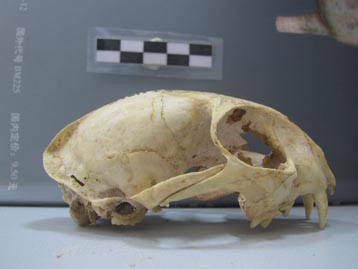
 © J.-D. Vigne, CNRS/MNHN Side view of a domestic cat skull from the Neolithic site of Wuzhuangguoliang .
Were domestic cats brought to China over 5 000 years ago? Or were small cats domesticated in China at that time? There was no way of deciding between these two hypotheses until a team from the 'Archéozoologie, Archéobotanique: Sociétés, Pratiques et Environnements' laboratory (CNRS/MNHN), in collaboration with colleagues from the UK and China
1, succeeded in determining the species corresponding to cat remains found in agricultural settlements in China, dating from around 3500 BC. All the bones belong to the leopard cat, a distant relation of the western wildcat, from which all modern domestic cats are descended. The scientists have thus provided evidence that cats began to be domesticated in China earlier than 3 000 BC. This scenario is comparable to that which took place in the Near East and Egypt, where a relationship between humans and cats developed following the birth of agriculture. Their findings
2 are published on 22 January 2016 in the journal PLOS ONE . The cat is the most common domestic animal in the world today, with over 500 million individuals. All of today's domestic cats descend from the African and Near Eastern form of the wildcat ( Felis silvestris lybica ). According to work published in 2004, humans and cats first started to form a close relationship in the Near East from 9000 to 7000 BC, following the birth of agriculture. In 2001, researchers from the Chinese Academy of Sciences in Beijing discovered cat bones in agricultural settlements in northern China (Shaanxi province) dating from around 3500 BC. Was this evidence of a relationship between small Chinese cats and humans in the fourth millennium BC in China?
TO READ THIS ARTICLE, CREATE YOUR ACCOUNT
And extend your reading, free of charge and with no commitment.
Your Benefits
- Access to all content
- Receive newsmails for news and jobs
- Post ads


