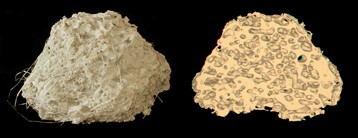
 © CRCA / CNRS (Toulouse) Nest of the black garden ant, Lasius niger, whose colonies comprise around five to fifteen thousand individuals. Left, epigeous part. Right, X-ray tomography image showing the internal structure made up of a large number of bubble-shaped chambers closely interlinked with each other.
Ants collectively build nests whose size can reach several thousand times that of individual ants and whose architecture is sometimes highly complex. However, their ability to coordinate several thousand individuals when building their nests remains a mystery. To understand the mechanisms involved in this process, researchers from CNRS, Université Toulouse III – Paul Sabatier and Université de Nantes
1 combined behavioral analysis, 3D imaging and computational modeling techniques. Their work shows that ants self-organize by interacting with the structures they build thanks to the addition of a pheromone to their building material. This chemical signal controls their building activity locally and determines the shape of the nest. Its breakdown over time and due to environmental conditions also enables the ants to adapt the shape of their nests. This work is published in PNAS on 18 January 2016.
TO READ THIS ARTICLE, CREATE YOUR ACCOUNT
And extend your reading, free of charge and with no commitment.
Your Benefits
- Access to all content
- Receive newsmails for news and jobs
- Post ads




