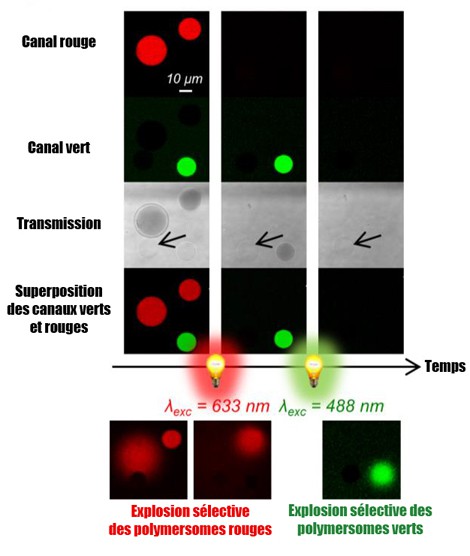
 © Peyret et al. 2016. Confocal microscope observations of three types of vesicles. In red, methylene blue-loaded vesicles; in green, calcein-loaded vesicles. Sucrose-loaded vesicles are indicated by an arrow. Laser irradiation of 633 nm then 488 nm ruptures the red and green vesicles in succession. The other vesicle remains intact.
Cells are the site of a multitude of chemical reactions, the precision of which is envied by scientists. A team of researchers from the CNRS and Bordeaux INP have neared this level of control by controlling the explosion of polymersomes through laser irradiation. These hollow polymer spheres, which can mimic certain cellular functions, react to a specific wavelength and thus release their content on demand. This research has been published in Angewandte Chemie International Edition . Polymersomes are artificial vesicles that can mimic organelles, compartments naturally found in nucleic cells. Here researchers encapsulated fluorescent molecules in “giant” polymersomes with a diameter of a dozen micrometers. These fluorescent groups have the characteristic of decomposing under the action of light, but only at a specific wavelength.
TO READ THIS ARTICLE, CREATE YOUR ACCOUNT
And extend your reading, free of charge and with no commitment.
Your Benefits
- Access to all content
- Receive newsmails for news and jobs
- Post ads