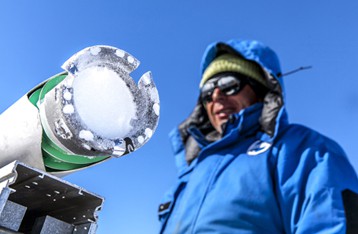
 © Thibaut VERGOZ / IPEV / LGGE / CNRS Photo library Sampling of an ice core during the testing of the prototype of the Mini-Subglacior experimental probe on the Concordia station in Antarctica. Within a single field season (2 to 3 months), the Subglacior probe will make it possible to explore the ice up to 3 km deep to obtain climatic recordings of the last 1.5 million years, the oldest data obtained from natural ice.
Why did the rhythm of glaciations suddenly slow down about a million years ago? To answer this question and to better forecast future climate change, a consortium of researchers from 14 institutions
1, including France's CNRS and IPEV, have set out to find ice that is at least 1.5 million years old. With €2.2 million funding over three years under the European Horizon 2020 program, this project aims to locate a site in Antarctica that would date back to more than 800,000 years, the maximum age of the ice extracted during the EPICA drilling carried out at Dome C. The studies will begin this year during the austral summer in two regions of Antarctica: one close to the Fuji dome and the other near the Concordia station. The French teams will test a new probe that dates the ice in real time, without the need for coring. The aim of the Beyond EPICA – Oldest Ice (BE-OI) project is to find Antarctic ice that is at least 1.5 million years old. Coordinated by the Alfred Wegener Institute in Germany, it involves both the CNRS and IPEV. Extracting a core of such old ice would solve one of the mysteries of paleoclimatology. Indeed, about a million years ago, the climate of the Earth underwent a major change in rhythm.
TO READ THIS ARTICLE, CREATE YOUR ACCOUNT
And extend your reading, free of charge and with no commitment.
Your Benefits
- Access to all content
- Receive newsmails for news and jobs
- Post ads