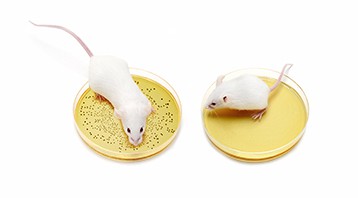
 © Vincent Moncorgé. In the mouse, the intestinal microbiota is necessary for optimum postnatal growth and thus contributes to determining the size of adult individuals. Left: an infant mouse reared with its intestinal microbiota; right: a young adult mouse devoid of intestinal microbiota. Note their difference in size. The bacterial colonization of the mice is illustrated by the presence or absence of colonies in bacterial cultures on agar plates.
The intestinal microbiota is necessary to ensure optimum postnatal growth and contributes to determining the size of adult individuals, notably in the event of undernutrition. The key element in this relationship is Insulin-like Growth Factor-1 (IGF-1), whose production and activity are in part controlled by the microbiota. This has recently been demonstrated in mice by scientists at the Institut de Génomique Fonctionnelle de Lyon (CNRS/ENS Lyon/Université Claude Bernard Lyon 1), the Laboratoire CarMeN (INSERM/INRA/Université Claude Bernard Lyon 1/Insa Lyon)
1, and Unit BF2I (INRA/INSA Lyon)
2. These findings also show that some strains of intestinal bacteria belonging to the Lactobacillus plantarum species may favor the postnatal growth of animals, thus offering a new opportunity to combat the harmful effects of chronic infantile undernutrition. During the juvenile phase, animal growth is influenced by interactions between nutritional intake and hormone signaling. Acute undernutrition for a few days in the mouse results in marked weight loss, which has been widely documented and attributed—among other factors—to a disturbance of the intestinal microbiota. Chronic undernutrition will result in the onset of growth retardation.
TO READ THIS ARTICLE, CREATE YOUR ACCOUNT
And extend your reading, free of charge and with no commitment.
Your Benefits
- Access to all content
- Receive newsmails for news and jobs
- Post ads