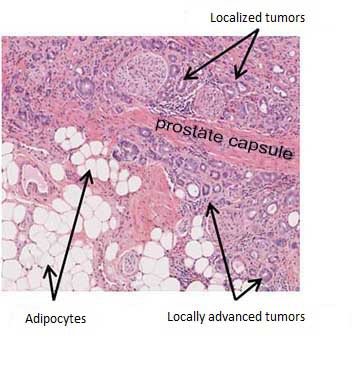
 © Catherine Muller Prostate cancer can remain localized in the prostate gland. There it has a “good prognosis”. Some tumors (called locally advanced tumors) will get through the prostate capsule and in this way could propagate throughout the body. This phenomenon is controlled by adipocytes in the periprostatic adipose tissue (white circles) via their ability to secrete chemokine CCL7. Obesity amplifies this phenomenon.
Obesity has direct consequences on health and is associated with the onset of aggressive cancers, but the mechanisms underlying this phenomenon are little known. Researchers from the Institut de Pharmacologie et Biologie Structurale (CNRS/Université Toulouse III - Paul Sabatier)
1 have recently elucidated one of these mechanisms in prostate cancer, one of the most common cancers in men: in obese patients, the adipose tissue surrounding the prostate gland facilitates the propagation of tumor cells outside the prostate. A patent
2 has been filed for these results 2016. The prostate is surrounded by a fatty deposit called periprostatic adipose tissue (PPAT). As prostate cancer progresses, tumor cells may infiltrate this periprostatic adipose tissue: this is a key step in the progression of this cancer, as it signals locally advanced disease (where the cancer can progress to nearby organs). This phenomenon is more frequent in obese patients, in whom the size and number of PPAT adipocyte cells are higher. These cells can secrete numerous bioactive molecules such as chemokines, which can attract other cells.
TO READ THIS ARTICLE, CREATE YOUR ACCOUNT
And extend your reading, free of charge and with no commitment.
Your Benefits
- Access to all content
- Receive newsmails for news and jobs
- Post ads


