400 million year old fish fossil reveals jaw structure linked to humans
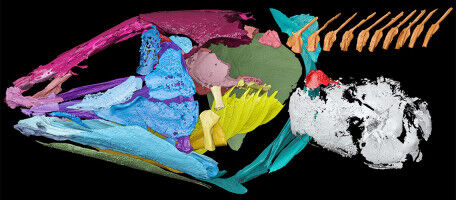
A new study from ANU on a 400 million year old fish fossil has found a jaw structure that is part of the evolutionary lineage linked to humans. The fossil comes from ancient limestones around Lake Burrinjuck, 50 kilometres northwest of Canberra. The area is rich in fossil shells and corals, but also home to the rare skulls of extinct armoured fish called placoderms. Co-researcher, ANU PhD scholar Yuzhi Hu, said this example was the best preserved skull and braincase of a placoderm ever found. "The fossil reveals, in intricate detail, the jaw structure of this ancient fish, which is part of the evolutionary lineage that ultimately led to humans," said Ms Hu from the ANU Research School of Earth Sciences. "The jaw joint in this ancient fish is still in the human skull, but is now part of the middle ear." The team used high-resolution CT scanning facilities at ANU to investigate the internal structure of the skull and braincase and produced high-resolution 3D printouts to reassemble the jaw elements - a technique never previously used for fossil vertebrates. Ms Hu analysed the CT scanning data to reveal a complete set of internal jaw cartilages for the first time in any placoderm, with structures surrounding the jaw joint different to all previous interpretations.