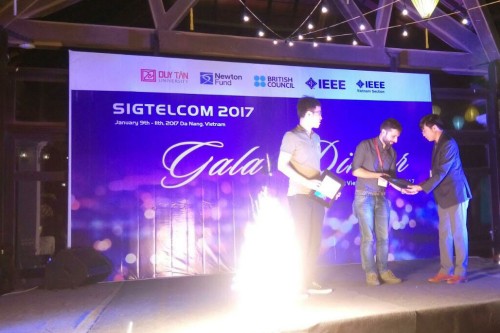
Image of Dr Andrea Tassi receiving his prize for best paper at the Signal Processing, Telecommunications & Computing (SigTelCom) 2017 conference.
New research that suggests a pre-existing 4G network infrastructure could help drivers make safe decisions in or near accidents has won the 'Best Paper Award' at an international conference. The research carried out by the University of Bristol Communication Systems & Networks (CSN) Group , in collaboration with the Université Blaise Pascal in France, was presented at the international conference Signal Processing, Telecommunications & Computing (SigTelCom) 2017 , supported by IEEE, Newton Fund and British Council. An important factor in vehicle-related accidents is the lack of information and if drivers are aware of their surroundings and road conditions, many accidents could be avoided. As driverless cars begin to gain momentum, improvements will be needed to ensure vehicles receive the correct information. A key question is how high-quality data can be shared by an Intelligent Transportation System (ITS) to help drivers in emergency situations. The research team suggest a cost-effective solution to this problem is for city-owned base stations to form a single frequency network (SFN), which will enable drivers to have the information they need to make safe decisions in or near accidents. In order to ensure that transmissions are reliable, tight bounds on the outage probability would need to be developed when the SFN is overlaid on an existing cellular network.
TO READ THIS ARTICLE, CREATE YOUR ACCOUNT
And extend your reading, free of charge and with no commitment.