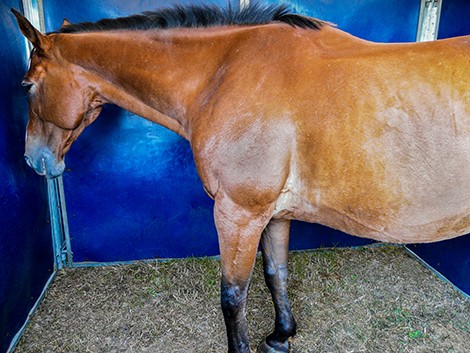
 © Martine Hausberger Horse exhibiting depressive-like behavior
The horse is “withdrawn” (neck lowered, immobile) and indifferent to the environment, as suggested by its position, facing the wall.
Like humans, horses work every day, which may have both physical and psychological consequences.
© Martine Hausberger Horse exhibiting depressive-like behavior
The horse is “withdrawn” (neck lowered, immobile) and indifferent to the environment, as suggested by its position, facing the wall.
Like humans, horses work every day, which may have both physical and psychological consequences.
Cortisol is generally considered to be a stress hormone because its levels rise during episodes of acute stress. Yet its relationship to chronic stress is less clear. Researchers from the Éthologie Animale et Humaine laboratory (CNRS / Université de Rennes 1 /Université of Caen) and the Research Institute for Environmental and Occupational Health (INSERM /Université de Rennes 1), in collaboration with the University of Veterinary Medicine in Vienna, have linked lower cortisol levels to states of chronically poor welfare in adult horses observed under their usual living conditions. Their findings are published in PLOS ONE (September 8, 2017). Cortisol, deemed the quintessential stress hormone, allows us to cope with important events and imminent threats. A spike in cortisol levels mobilizes necessary resources—such as by tapping into our body's reserves to produce energy—and then allows us to return to a stable state. But can our bodies cope with prolonged or repeated stress in the same way? Some studies report lower cortisol levels in humans —or other mammals—subject to chronic stress, while other studies contradict these findings.
TO READ THIS ARTICLE, CREATE YOUR ACCOUNT
And extend your reading, free of charge and with no commitment.
Your Benefits
- Access to all content
- Receive newsmails for news and jobs
- Post ads