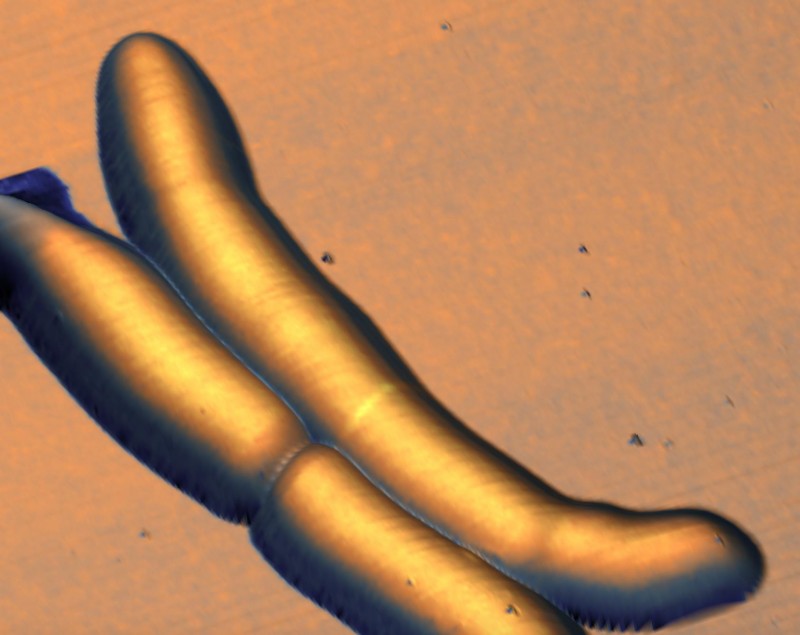
 The wave-trough division site in M. smegmatis as seen with the techniques developed in this study
EPFL scientists show how some pathogenic bacteria - such as the mycobacteria that cause tuberculosis - use a previously unknown mechanism to coordinate their division. The discovery could help develop new ways to fight them. Most rod-shaped bacteria divide by splitting into two around the middle after their DNA has replicated safely and segregated to opposite ends of the cell. This seemingly simple process actually demands tight and precise coordination, which is achieved through two biological systems: nucleoid occlusion, which protects the cell's genetic material from dividing until it replicates and segregates, and the 'minicell' system, which localizes the site of division around the middle of the cell, where a dividing wall will form to split it in two. But some pathogenic bacteria, e.g. Mycobacterium tuberculosis , don't use these mechanisms. EPFL scientists have now combined optical and atomic force microscopy to track division in such bacteria for the first time, and have discovered that they use instead an undulating 'wave-pattern' along their length to mark future sites of division. The findings are published in Nature Microbiology .
TO READ THIS ARTICLE, CREATE YOUR ACCOUNT
And extend your reading, free of charge and with no commitment.
Your Benefits
- Access to all content
- Receive newsmails for news and jobs
- Post ads