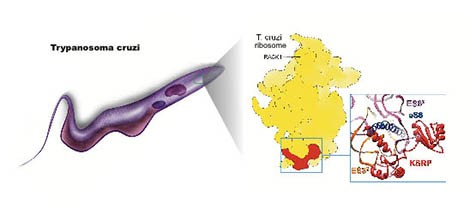
 © Yaser Hashem. Ribosome of the parasite Trypanosoma cruzi . Illustration of the cytosolic ribosome in trypanosomes, purified from the T. cruzi parasite. Structure analysis by cryo-electron microscopy (middle) of the ribosome shows a new protein that is specific to this family of organisms. This protein has been named Kinetoplastid-specific ribosomal protein, or KSRP. In spite of its constant presence, this protein has passed unnoticed for years, even after the first publication of the high-resolution structure of this ribosome.
Yaser Hashem's team at the Laboratoire Architecture et Réactivité de l'ARN at CNRS's has discovered a new potential therapeutic target – located in the ribosome – to combat trypanosomes parasites. Using cryo-electron microscopy
1, researchers at the Institut de Biologie Moléculaire et Cellulaire (CNRS/Université de Strasbourg) have analyzed the structure of these parasites in details and revealed one of their potential weak points, which has remained undetected until now. This discovery opens the path to the development of new safer therapies that are less toxic and more specific against trypanosomes, the parasites causing the Chagas disease and the African sleeping sickness. This study is published on October 26, 2017 in Structure . Trypanosomes, more generally called kinetoplastids, are unicellular parasites responsible for numerous diseases of variable severity that can be lethal in the most severe cases. Trypanosoma brucei , Trypanosoma cruzi and Leishmania major are probably the best known and cause the African sleeping sickness, Chagas disease and various Leishmaniasis, respectively. Unlike bacteria, these organisms are eukaryotic cells that contain a nucleus, just like human cells.
TO READ THIS ARTICLE, CREATE YOUR ACCOUNT
And extend your reading, free of charge and with no commitment.
Your Benefits
- Access to all content
- Receive newsmails for news and jobs
- Post ads