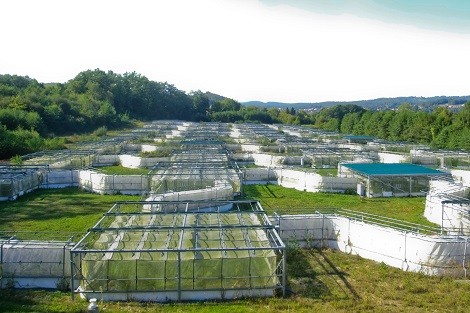
 © E.Bestion The Metatron, an experimental facility for studying effects of global warming .
The deleterious effects of climate change on bacterial species composing the gut microbiota
1 of a lizard have been demonstrated by researchers from the Evolution and Biological Diversity laboratory in Toulouse (CNRS / Université Toulouse III—Paul Sabatier / ENSFEA / IRD), the Theoretical and Experimental Ecology Station (CNRS / Université Toulouse III—Paul Sabatier), and the University of Exeter in Great Britain
2. Nature Ecology & Evolution will be publishing this work, which highlights the need to better understand the effects of climate on ecological relationships between species—and thereby adopt more appropriate measures for their protection. Global warming changes how the ecosystems within which species interact function. Moreover, this encompasses all species, including the bacteria within digestive tracts that make up gut microbiotas. The microbiota plays an essential role in the digestive and immune functions of its host. Consequently, microbiotic imbalances caused by climate change could be detrimental to the survival of host species. In a recent study, researchers quantified the impact of simulated global warming on the microbiota of a reptile, the common lizard.
TO READ THIS ARTICLE, CREATE YOUR ACCOUNT
And extend your reading, free of charge and with no commitment.
Your Benefits
- Access to all content
- Receive newsmails for news and jobs
- Post ads