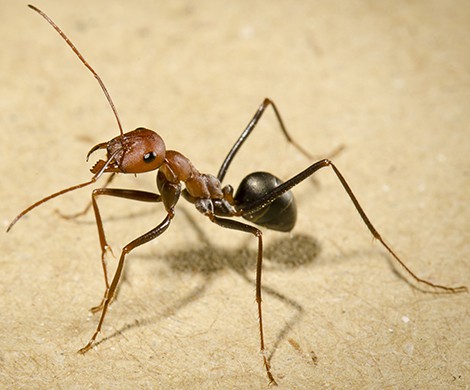
An international team including researchers at the university of Edinburgh and Antoine Wystrach of the Research Centre on Animal Cognition (CNRS/Université Toulouse III—Paul Sabatier) has shown that ants can get their bearings whatever the orientation of their body. Their brains may be smaller than the head of a pin, but ants are excellent navigators that use celestial and terrestrial cues to memorize their paths. To do so, they use several regions of the brain simultaneously, proving once again that the brain of insects is more complex than thought. The researchers' findings were published in Current Biology on January 19, 2017. Until now, ethological research suggested that ants memorized the scenery perceived along their route as it is projected on their multifaceted retinas—thus using a body-centered, or egocentric , frame of reference. By this hypothesis, to recognize memorized surroundings and follow a path formerly traveled, ants would need to orient their bodies in the same way each time. But they sometimes need to walk backwards as well, and this doesn't prevent them from finding their way back to their nest.
TO READ THIS ARTICLE, CREATE YOUR ACCOUNT
And extend your reading, free of charge and with no commitment.
Your Benefits
- Access to all content
- Receive newsmails for news and jobs
- Post ads