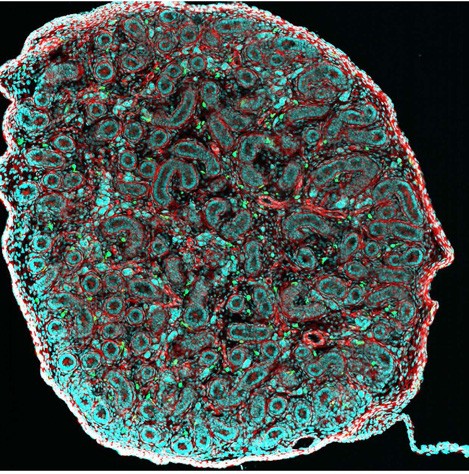
 © Noushine Mossadegh-Keller and Sébastien Mailfert / CIML Cross section of newborn mouse’s testis (Ø = 20 µm), where we can see the seminiferous tubules (red) surrounded by macrophages (green). Confocal micrograph.
The origin, development, and characteristics of two types of testicular macrophage have been described by a CNRS team at the Centre d'Immunologie de Marseille-Luminy (CNRS / INSERM / Aix-Marseille University). To elucidate the nature of these immune cells, the researchers used a novel cell tracing method. Their findings were published on August 7, 2017, in the Journal of Experimental Medicine , and are of fundamental importance. They may help understand certain kinds of infertility in men and find new treatments for them. From the start of life, an individual's immune system learns to distinguish self—that is, native cells—from other, potentially pathogenic cells. But in males, as sperm only appear at puberty, they may be mistaken for foreign cells by certain elements of the immune system. Testicular macrophages are special immune cells that rush to the defense of sperm.
TO READ THIS ARTICLE, CREATE YOUR ACCOUNT
And extend your reading, free of charge and with no commitment.
Your Benefits
- Access to all content
- Receive newsmails for news and jobs
- Post ads