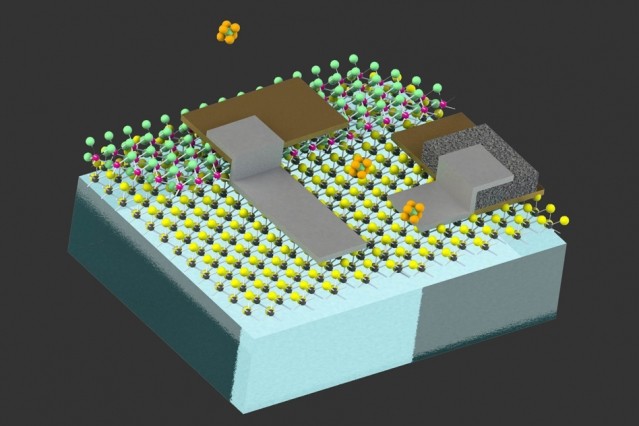
Optical images show circuits made by the research team, prior to being attached to particles just a few hundred nanometers across.
Researchers at MIT have created what may be the smallest robots yet that can sense their environment, store data, and even carry out computational tasks. These devices, which are about the size of a human egg cell, consist of tiny electronic circuits made of two-dimensional materials, piggybacking on minuscule particles called colloids. Colloids, which insoluble particles or molecules anywhere from a billionth to a millionth of a meter across, are so small they can stay suspended indefinitely in a liquid or even in air. By coupling these tiny objects to complex circuitry, the researchers hope to lay the groundwork for devices that could be dispersed to carry out diagnostic journeys through anything from the human digestive system to oil and gas pipelines, or perhaps to waft through air to measure compounds inside a chemical processor or refinery. "We wanted to figure out methods to graft complete, intact electronic circuits onto colloidal particles," explains Michael Strano, the Carbon C. Dubbs Professor of Chemical Engineering at MIT and senior author of the study, which was published today . MIT postdoc Volodymyr Koman is the paper's lead author. "Colloids can access environments and travel in ways that other materials can't," Strano says.
TO READ THIS ARTICLE, CREATE YOUR ACCOUNT
And extend your reading, free of charge and with no commitment.