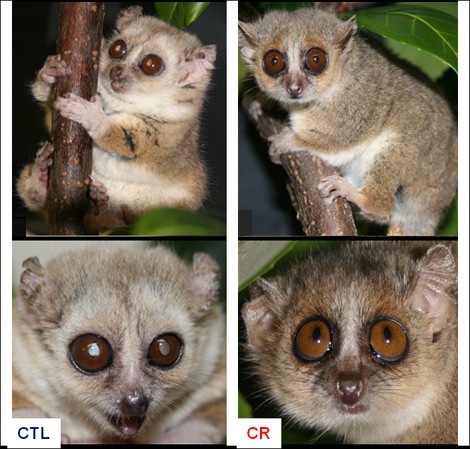
 © CNRS/MNHN Example of two 9-year-old mouse lemurs in the Restrikal cohort.
The animal on the left, which weighs around 100 g, has been fed a “normal” diet throughout its life (CTL). It presents characteristics that are frequently observed among elderly mouse lemurs: cataracts and whitening of the fur.
The animal on the right, which weighs around 70 g, has been fed 30% fewer calories (CR) compared to the control group since early adult life. It has the morphological characteristics of a younger animal.
© CNRS/MNHN Example of two 9-year-old mouse lemurs in the Restrikal cohort.
The animal on the left, which weighs around 100 g, has been fed a “normal” diet throughout its life (CTL). It presents characteristics that are frequently observed among elderly mouse lemurs: cataracts and whitening of the fur.
The animal on the right, which weighs around 70 g, has been fed 30% fewer calories (CR) compared to the control group since early adult life. It has the morphological characteristics of a younger animal.
Chronic caloric restriction strongly increases the lifespan of a small primate, the grey mouse lemur. This is one of the results of a ten-year experiment conducted by researchers at the CNRS and the French National Museum of Natural History (MNHN), in partnership with other French teams.
1 Chronic caloric restriction consists in eating a reduced but balanced diet from the outset of early adulthood. Its beneficial effect on lifespan had been established for many short-lived species (worms, flies, mice), but remained controversial for primates, including humans. Another observation is that the aging process is delayed among animals on a reduced diet. This research is published on April 5, 2018 in the journal Communications Biology . Chronic caloric restriction consists in eating a reduced but balanced diet from early adult life onward. Previous research, into macaques in particular (which have an average lifespan of forty years), had already demonstrated its beneficial effect on the incidence of age-related pathologies.
TO READ THIS ARTICLE, CREATE YOUR ACCOUNT
And extend your reading, free of charge and with no commitment.
Your Benefits
- Access to all content
- Receive newsmails for news and jobs
- Post ads