Source: Wellcome
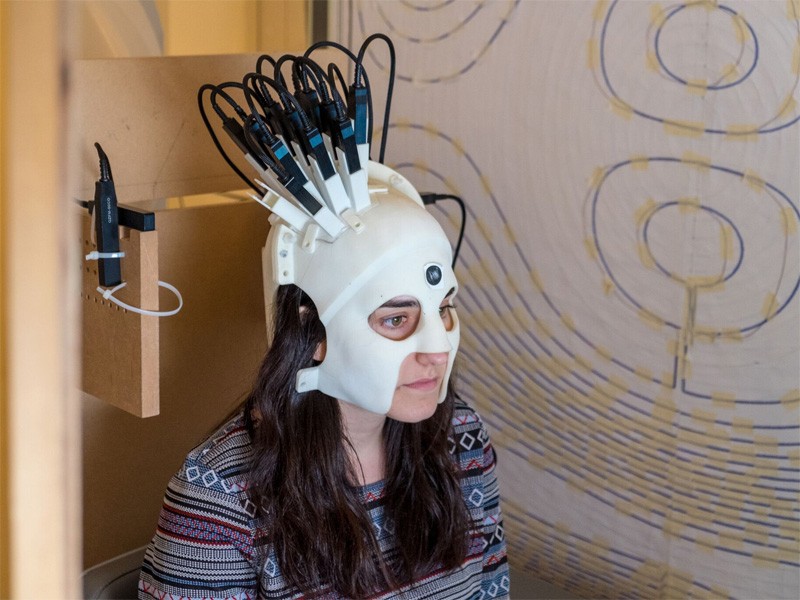
Researchers at UCL and the University of Nottingham have mapped the brain's language area in the first study of human cognition using a new generation of brain scanner that can be worn like a helmet. This marks an important step forward in the translation of their new technique from the laboratory bench to a genuinely useful tool for cognitive neuroscience and clinical application, enabling researchers to scan the brains of people while they move about. The study, published in NeuroImage , was conducted by researchers at the UCL Wellcome Centre for Human Neuroimaging and the Sir Peter Mansfield Imaging Centre, University of Nottingham. "From a neuroscience perspective this work is very exciting as it allows us to study tasks that we could never have contemplated before with conventional scanners (where the head has to remain fixed)," said co-lead author Professor Gareth Barnes (UCL Wellcome Centre for Human Neuroimaging). "For example, people interacting naturally or people navigating through virtual worlds and laying down memories. Importantly, we can do this throughout the lifespan - allowing us to understand how key functions like memory or language develop and how they degrade in dementia." Using the new wearable magnetoencephalography (MEG) system the research team were able to map the parts of the brain responsible for language. Brain cells operate and communicate by producing electrical currents that generate tiny magnetic fields that can be detected outside the head using MEG scanners.
TO READ THIS ARTICLE, CREATE YOUR ACCOUNT
And extend your reading, free of charge and with no commitment.