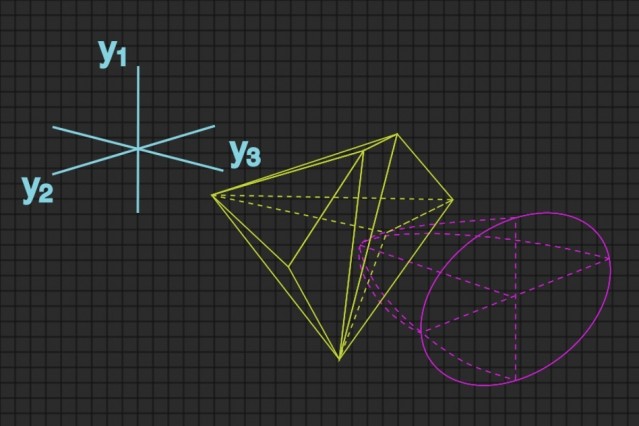
A new theoretical analysis of wireless localization systems represents settings of a wireless network (yellow) and measurement error (purple) as three-dimensional spaces. The intersection of the two spaces defines the network’s optimal configuration.
With billions of GPS devices in use today, people are beginning to take it for granted that services on their handheld devices will be location-aware. But GPS doesn't work well indoors, and it's not precise enough for several potentially useful applications, such as locating medical equipment in hospitals or pallets of goods in warehouses, or helping emergency responders navigate unfamiliar buildings. Professor of aeronautics and astronautics Moe Win has spent the last decade investigating the theory and practice of using wireless signals to gauge location. In 2010, his group published a series of papers deriving fundamental limits on the accuracy of systems that infer wireless transmitters' locations based on features of their signals, such as power, angle of arrival, and time of flight. In the February issue of the journal IEEE Transactions on Information Theory , Win and two colleagues - Wenhan Dai, an MIT graduate student in aeronautics and astronautics, and Yuan Shen, an associate professor of electronic engineering at Tsinghua University, who did his graduate work at MIT - expand on those results. First, they show how changing a wireless localization system's parameters - such as the power, bandwidth, and duration of its transmissions - alters the fundamental limits on its accuracy. This, in turn, allows them to determine the system configuration that yields the most accurate location inferences.
TO READ THIS ARTICLE, CREATE YOUR ACCOUNT
And extend your reading, free of charge and with no commitment.