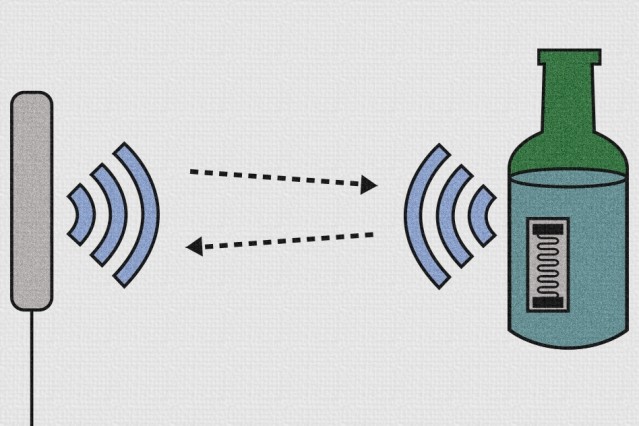
MIT Media Lab researchers have developed a wireless system that leverages the cheap RFID tags already on hundreds of billions of products to sense potential food contamination. Image courtesy of the researchers, edited by MIT News
Simple, scalable wireless system uses the RFID tags on billions of products to sense contamination. MIT Media Lab researchers have developed a wireless system that leverages the cheap RFID tags already on hundreds of billions of products to sense potential food contamination - with no hardware modifications needed. With the simple, scalable system, the researchers hope to bring food-safety detection to the general public. Food safety incidents have made headlines around the globe for causing illness and death nearly every year for the past two decades. Back in 2008, for instance, 50,000 babies in China were hospitalized after eating infant formula adulterated with melamine, an organic compound used to make plastics, which is toxic in high concentrations. And this April, more than 100 people in Indonesia died from drinking alcohol contaminated, in part, with methanol, a toxic alcohol commonly used to dilute liquor for sale in black markets around the world. The researchers' system, called RFIQ, includes a reader that senses minute changes in wireless signals emitted from RFID tags when the signals interact with food.
TO READ THIS ARTICLE, CREATE YOUR ACCOUNT
And extend your reading, free of charge and with no commitment.