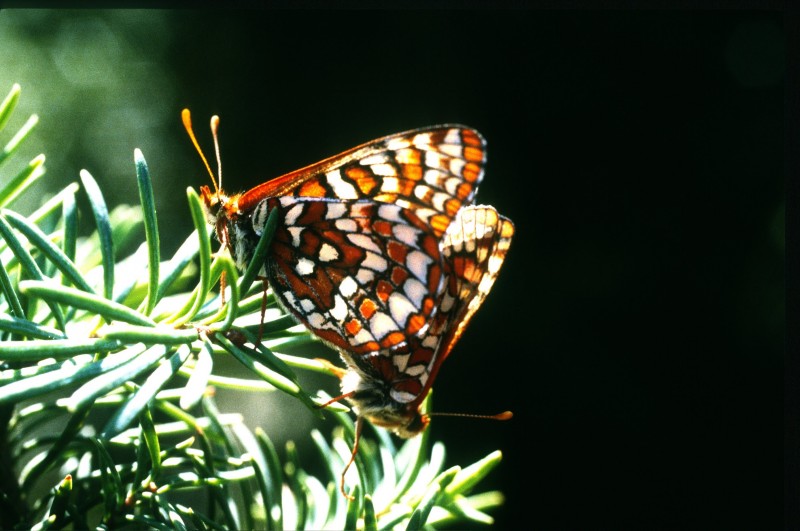
A mating pair of Edith’s checkerspot, which are the focus of a new study showing how wild species can be caught in "eco-evolutionary traps" when humans introduce new resources in the environment and then quickly take them away. Singer & Parmesan
New research into the Edith's checkerspot butterfly shows how wild species react to human-induced changes to their environment. Camille Parmesan AUSTIN, Texas - New research confirms that wild species can adapt quickly to human-induced changes, but also shows how such adaptation can cause those species to be caught in deadly "eco-evolutionary traps" when humans introduce new resources in the environment and then quickly take them away. The study, by researchers from the University of Plymouth and The University of Texas at Austin, was released May 9 in Nature and will be the journal's cover story on May 10 . In the study, researchers followed a large, isolated population of Euphydryas butterflies on a Nevada ranch. The butterflies in the area had historically fed on a native plant, but researchers documented how the study population evolved complete dependence on a European weed introduced to Nevada with cattle ranching more than 100 years ago. The butterfly population then quickly died off shortly after cattle ranching ended in 2005, a change that effectively eliminated the weed for use by the butterfly, springing what researchers dubbed an eco-evolutionary trap. European conservation biologists have long believed this type of process is underlying widespread butterfly population extinctions across Europe, but in Europe the evolution of dependence on human management occurred before anyone documented it.
TO READ THIS ARTICLE, CREATE YOUR ACCOUNT
And extend your reading, free of charge and with no commitment.