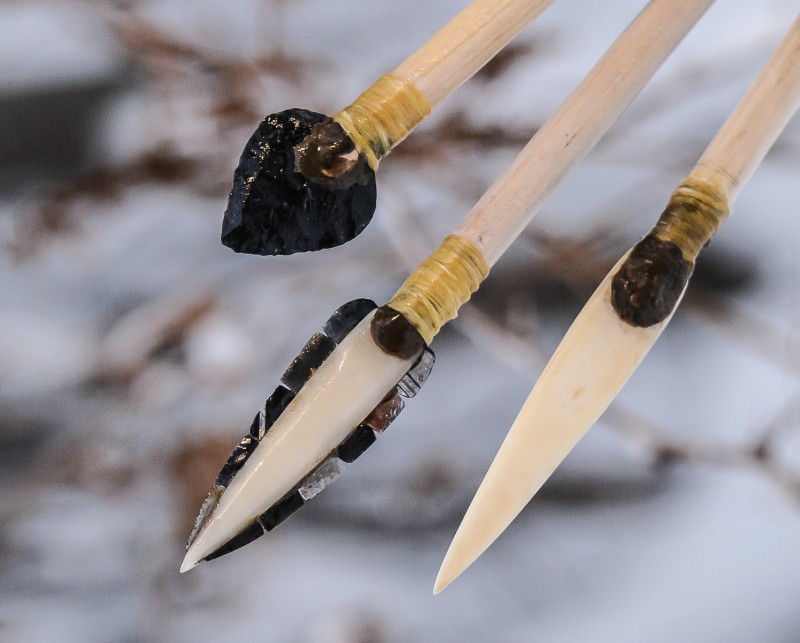
University of Washington researchers re-created ancient projectile points to test their effectiveness. From left to right: stone, microblade and bone tips. Janice Wood
Archaeologists are a little like forensic investigators: They scour the remains of past societies, looking for clues in pottery, tools and bones about how people lived, and how they died. And just as detectives might re-create the scene of a crime, University of Washington archaeologists have re-created the weapons used by hunter-gatherers in the post-Ice Age Arctic some 14,000 years ago. Looking for clues as to how those early people advanced their own technology, researchers also considered what that might tell us about human migration, ancient climates and the fate of some animal species. In an article published Jan. 31 in the Journal of Archaeological Science, Janice Wood , recent UW anthropology graduate, and Ben Fitzhugh , a UW professor of anthropology, show how they reconstructed prehistoric projectiles and points from ancient sites in what is now Alaska and studied the qualities that would make for a lethal hunting weapon. The UW team chose to study hunting weapons from the time of the earliest archaeological record in Alaska (around 10,000 to 14,000 years ago), a time that is less understood archaeologically, and when different kinds of projectile points were in use. Team members designed a pair of experiments to test the effectiveness of the different point types.
TO READ THIS ARTICLE, CREATE YOUR ACCOUNT
And extend your reading, free of charge and with no commitment.