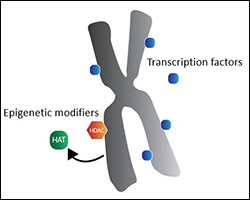
Mitotic chromosome: most transcription factors bind mitotic chromatin to varying degrees. Retention of epigenetic modifiers is more pathway specific; while proteins associated with transcription are often evicted (ex. Histone acetyltransferases, HATs), those associated with transcriptional repression remain bound (ex. Histone deacetylases, HDACs).
Differential recruitment of proteins to chromatin is fundamental in eukaryotes to regulate transcription, replication, and cell division. Yet it is unclear how the regulatory landscape is transmitted through cell division since many proteins are thought to be evicted during mitosis, when the chromosomes condensate. A recently published study by the Schübeler group suggests that many transcription factors actually remain bound and could serve as 'bookmark' throughout mitosis. In order to interrogate the binding behavior of chromatin proteins during the cell cycle, Paul Ginno from the Schübeler group and collaborators developed a novel mass spectrometry-based approach, namely biophysical separation of formaldehyde cross-linked protein-DNA complexes, to quantify the chromatin-associated proteome at separate stages of the cell cycle. Critical to the success of this project was the close collaboration with the Proteomics and Protein Analysis Facility, headed by Jan Seebacher. The study, which was published last week, suggests that mitotic retention of transcription factors is more widespread than previously appreciated. The authors speculate that this persistent binding serves to reinitiate transcriptional programs more readily post mitosis.
TO READ THIS ARTICLE, CREATE YOUR ACCOUNT
And extend your reading, free of charge and with no commitment.