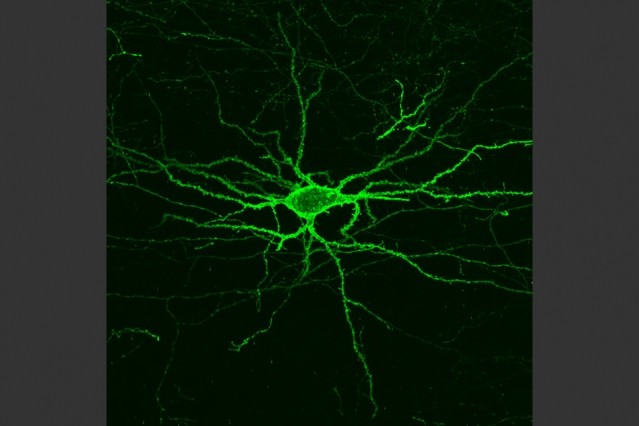
MIT researchers have developed a light-sensitive protein that can be embedded into neuron membranes, where it emits a fluorescent signal that indicates how much voltage a particular cell is experiencing. This could allow scientists to study how neurons behave, millisecond by millisecond, as the brain performs a particular function.
Neurons in the brain communicate via rapid electrical impulses that allow the brain to coordinate behavior, sensation, thoughts, and emotion. Scientists who want to study this electrical activity usually measure these signals with electrodes inserted into the brain, a task that is notoriously difficult and time-consuming. MIT researchers have now come up with a completely different approach to measuring electrical activity in the brain, which they believe will prove much easier and more informative. They have developed a light-sensitive protein that can be embedded into neuron membranes, where it emits a fluorescent signal that indicates how much voltage a particular cell is experiencing. This could allow scientists to study how neurons behave, millisecond by millisecond, as the brain performs a particular function. "If you put an electrode in the brain, it's like trying to understand a phone conversation by hearing only one person talk," says Edward Boyden, an associate professor of biological engineering and brain and cognitive sciences at MIT. "Now we can record the neural activity of many cells in a neural circuit and hear them as they talk to each other." Boyden, who is also a member of MIT's Media Lab, McGovern Institute for Brain Research, and Koch Institute for Integrative Cancer Research, and an HHMI-Simons Faculty Scholar, is the senior author of the study, which appears in the Feb.
TO READ THIS ARTICLE, CREATE YOUR ACCOUNT
And extend your reading, free of charge and with no commitment.