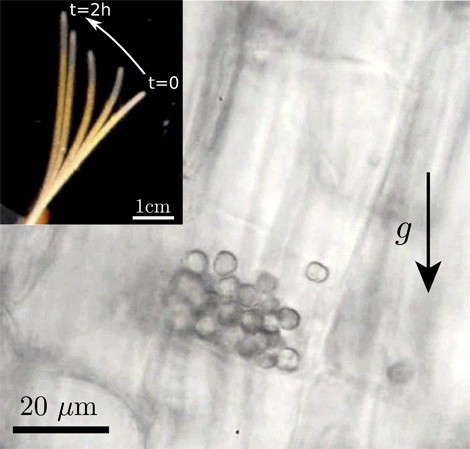
 © Yoel Forterre/Olivier Pouliquen/PNAS Inset: Wheat coleoptile growing upward after being inclined. Closeup of cell showing pile of statoliths (microscopic starch-filled grains) that enables the plant to detect gravity.
Plants can detect the slightest angle of inclination. Yet the mechanism by which they sense gravity relies on microscopic grains. In theory, such a system should hardly allow for precise detection of inclination. Researchers from the CNRS, the French National Institute of Agronomic Research (INRA), and Université Clermont Auvergne have now explained this curious paradox. They observed that, within the plant cells, the grains are constantly being agitated. This endows them collectively with properties similar to those of a liquid so that they act in unison like a carpenter's level. These findings were published in PNAS April 30, 2018.
TO READ THIS ARTICLE, CREATE YOUR ACCOUNT
And extend your reading, free of charge and with no commitment.
Your Benefits
- Access to all content
- Receive newsmails for news and jobs
- Post ads