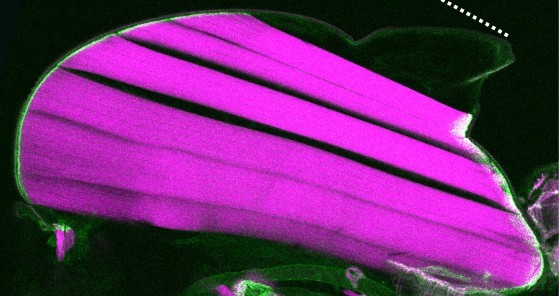
 Lengthwise cut through the thorax of a fruit fly having an inserted force sensor in the talin protein. The force sensor on the muscle-tendon connections is green and the flight muscles magenta.
Muscles are connected to tendons to power animal movements such as running, swimming or flying. Forces are produced by contractile chains of the proteins actin and myosin, which are pulling on muscle-tendon connections called attachments. During animal development, these muscle-tendon attachments must be established such that they resist high mechanical forces for the entire life of the animal. An interdisciplinary team of researchers from Marseille (France), Munich and Münster (both Germany) has now been able to quantify the mechanical forces transmitted by a key attachment protein called Talin. The researchers used the flight muscles of the fruit fly Drosophila for these molecular force measurements and found that a surprisingly small proportion of Talin molecules experiences detectable forces at developing muscle-tendon attachments. They also found that muscles deal with the increasing tissue forces by recruiting a high number of Talin molecules to attachments. This way, many Talin molecules can dynamically share the high peak forces produced during muscle contractions, for example while flying.
TO READ THIS ARTICLE, CREATE YOUR ACCOUNT
And extend your reading, free of charge and with no commitment.
Your Benefits
- Access to all content
- Receive newsmails for news and jobs
- Post ads