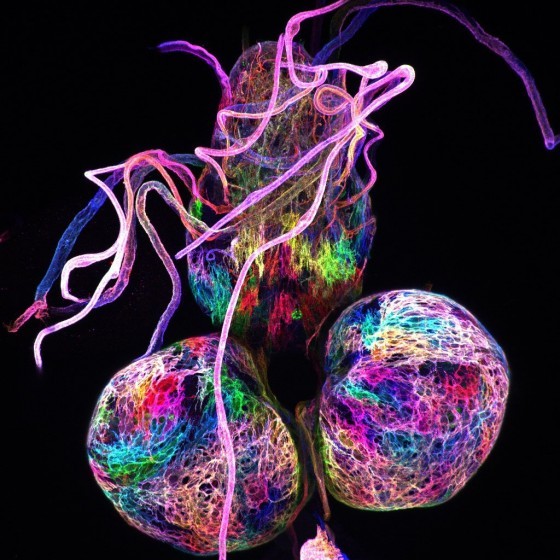
 The outermost layer of cells in the blood-brain barrier in the central nervous system of a fruit fly larva (third larval phase). A special protein marking procedure was used to render the individual cells visible in various colors. The spherical structures are the two hemispheres of the brain. Beneath them is the ventral nerve cord, from which nerves extend to the muscles.
They take up little space and are easy to breed; because they are easy to look after, fruit flies or Drosophila melanogaster are used as laboratory animals in research institutes all over the world. However, that is not the only reason why they are one of the most important model organisms that are studied by geneticists. Another important reason is that their genetic make-up, which is readily comprehensible, has been completely decoded and is easy to manipulate. In addition, many of the findings that scientists arrive at by studying flies can be transferred to other organisms. By examining the fly's brain, we can therefore gain a better understanding of the way human brains work. "Many characteristics of the brain's metabolism are phylogenetically preserved. That means that the processes which take place in a fly's brain resemble those in a human brain.
TO READ THIS ARTICLE, CREATE YOUR ACCOUNT
And extend your reading, free of charge and with no commitment.
Your Benefits
- Access to all content
- Receive newsmails for news and jobs
- Post ads