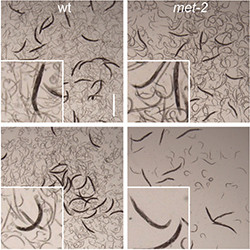
Genome wide RNAi synthetic lethality screen in C. elegans
The heterochromatin of eukaryotes contains repetitive DNA, which can lead to genome instability when transcribed. These sequences are normally silenced through the methylation of lysine 9 in histone H3 (H3K9me). Researchers from the Gasser group explored the role and importance of H3K9me. In two recent publications, they shed light on how the process is regulated and how loss of H3K9me renders cells sensitive to the loss of the breast tumor suppressor, BRCA1. It is unclear why, but our genomes are riddled with repetitive DNA. Some repeats are remnants of viral invasion, but others are simple arrays of repeating motifs, sometimes only three or four letters long. These repeats do not encode proteins nor serve as gene regulatory elements, and they are transcriptionally silent most of the time, thanks to the methylation of lysine 9 in histone H3 (H3K9me).
TO READ THIS ARTICLE, CREATE YOUR ACCOUNT
And extend your reading, free of charge and with no commitment.