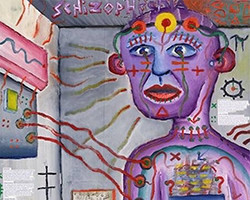
 Self-portrait of a person with schizophrenia, representing that individual’s perception of the distorted experience of reality in the disorder.
Although predisposing processes occur earlier, schizophrenia breaks out at young adulthood, suggesting it might involve a pathological transition during late brain development in predisposed individuals. Using a genetic mouse model of schizophrenia, researchers from the Caroni group at the FMI showed that, like in patients, characteristic network and cognitive deficits only emerge in adult mice. They then demonstrated that these deficits could all be permanently prevented by specific treatments during a late adolescence sensitive time window. Schizophrenia - affecting about 1% of the worldwide population - is a mental disorder characterized by disorganized thoughts, false beliefs, difficulty in social relationships, cognitive deficits, abnormal motor behavior, as well as blunted emotions and motivation. A notable feature of this severe, chronic condition is that its symptoms first emerge at the transition between late adolescence and young adulthood. Schizophrenia treatments focus on the symptoms and often consist of antipsychotic medications. The causes of schizophrenia are complex.
TO READ THIS ARTICLE, CREATE YOUR ACCOUNT
And extend your reading, free of charge and with no commitment.
Your Benefits
- Access to all content
- Receive newsmails for news and jobs
- Post ads