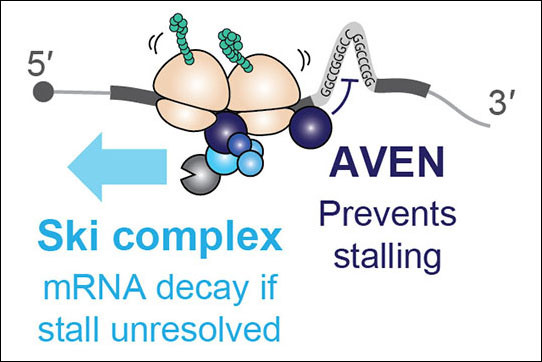
 Schematic diagram summarizing key findings: AVEN prevents ribosome stalls and the Ski complex eliminates transcripts if the stall is unresolved. ’We have identified a universal surveillance program, important for cell division and likely to play a role in certain cancers.’ Alex Tuck Research Overview Research Areas Scientific Publications Awards & Honors Partnerships Research Groups Overview Epigenetics Quantitative Biology Neurobiology Former Group Leaders Technology Platforms Overview C. elegans Facility Cell Sorting (FACS) Computional Biology Facility for Advanced Imaging and Microscopy Functional Genomics Proteomics & Protein Analysis Education & Careers Overview PhD & MD-PhD Programs Postdoctoral Activities Teaching Open Positions Working at the FMI Equality & Diversity Living in Basel Alumni About Overview FMI at a Glance Organization & Leadership Scientific Advisory Board History Contact News & Events Overview News Resources Seminars & Events 2020 © FMI Basel Switzerland About this site Extranet
Schematic diagram summarizing key findings: AVEN prevents ribosome stalls and the Ski complex eliminates transcripts if the stall is unresolved. 'We have identified a universal surveillance program, important for cell division and likely to play a role in certain cancers.' Alex Tuck Research Overview Research Areas Scientific Publications Awards & Honors Partnerships Research Groups Overview Epigenetics Quantitative Biology Neurobiology Former Group Leaders Technology Platforms Overview C. elegans Facility Cell Sorting (FACS) Computional Biology Facility for Advanced Imaging and Microscopy Functional Genomics Proteomics & Protein Analysis Education & Careers Overview PhD & MD-PhD Programs Postdoctoral Activities Teaching Open Positions Working at the FMI Equality & Diversity Living in Basel Alumni About Overview FMI at a Glance Organization & Leadership Scientific Advisory Board History Contact News & Events Overview News Resources Seminars & Events 2020 © FMI Basel Switzerland About this site Extranet (FMI only) - RNA decay plays a fundamental role in gene expression by controlling the quality and quantity of messenger RNAs. However, it has proved difficult to study and is still shrouded in mystery. Scientists from the Bühler group now uncovered key targets, components and functions of mammalian RNA decay pathways, and found that RNA decay is tightly connected to another crucial stage of gene expression: protein synthesis (translation). RNA decay (or degradation) is a key modulator of gene expression as it counterbalances the rate of transcription by eliminating transcripts when they are no longer needed.
TO READ THIS ARTICLE, CREATE YOUR ACCOUNT
And extend your reading, free of charge and with no commitment.
Your Benefits
- Access to all content
- Receive newsmails for news and jobs
- Post ads