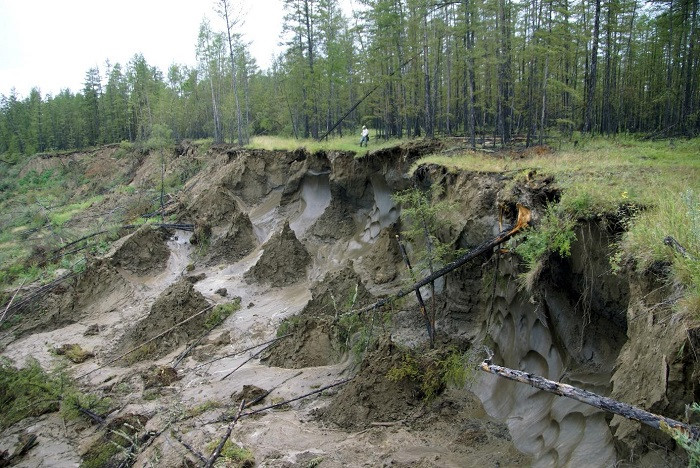
 Slumping of ice-rich permafrost in Central Yakutiya, Siberia.
Slumping of ice-rich permafrost in Central Yakutiya, Siberia. A. Séjourné, GEOPS (CNRS / Université Paris-Saclay) Erosion of the frozen soil of Arctic regions, known as permafrost, is creating large areas of subsidence, which has catastrophic impact in these regions sensitive to climate change. As the mechanisms behind these geological events are poorly understood, researchers from the Géosciences Paris Sud (GEOPS) laboratory (CNRS / Université Paris-Saclay), in cooperation with the Melnikov Permafrost Institute in Yakutsk, Russia, conducted a cold room 1 simulation of landslides, or slumps, caused by accelerated breakdown of the permafrost. The scientists demonstrated that the ice content of permafrost greatly contributes to soil collapse. They noted that very heterogeneous frozen soils, characterized by the presence of vertical ice wedges, 2 undergo major deformation during thaws. At those times, warm air circulates more freely, which furthers slumping. Such erosion during the warming phase, coupled with the input of excess water, accelerates melting and causes subsidence at the base of the ice layer.
TO READ THIS ARTICLE, CREATE YOUR ACCOUNT
And extend your reading, free of charge and with no commitment.
Your Benefits
- Access to all content
- Receive newsmails for news and jobs
- Post ads