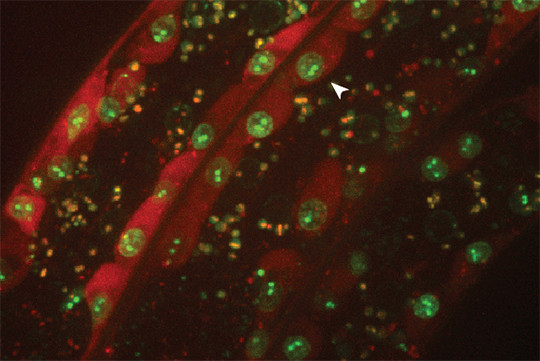
The double mutant C.elegans bearing both the laminopathy causing mutation and the deletion of CEC-4. In red, the muscle cells; in green, the cell nuclei with a specific muscle gene promoter tagged in GFP. In this double mutant, the gene is located internally, as in healthy worms. In worms with only the lamin mutation, the muscle gene would be sequestered at the nuclear periphery.
The double mutant C.elegans bearing both the laminopathy causing mutation and the deletion of CEC-4. In red, the muscle cells; in green, the cell nuclei with a specific muscle gene promoter tagged in GFP. In this double mutant, the gene is located internally, as in healthy worms. In worms with only the lamin mutation, the muscle gene would be sequestered at the nuclear periphery. Mutations in the nuclear structural protein lamin A produce rare, tissue-specific diseases called laminopathies. To study these diseases, researchers from the Gasser group introduced a mutation inducing a human laminopathy in C. elegans and monitored its effect on chromatin. Not only did they understand the molecular basis of the disease, they found a way to counteract the dominant defects of the mutation, suggesting a novel therapeutic pathway.
TO READ THIS ARTICLE, CREATE YOUR ACCOUNT
And extend your reading, free of charge and with no commitment.