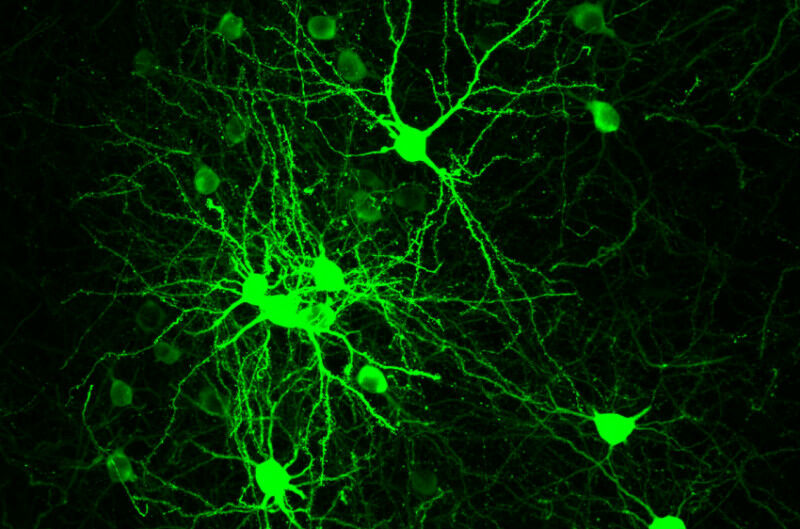
By imaging excitatory neurons (green) in the amygdala, FMI researchers uncovered opposing patterns of activity when mice switched between social engagement or spatial interaction and self-centered behaviors.
By imaging excitatory neurons ( green ) in the amygdala, FMI researchers uncovered opposing patterns of activity when mice switched between social engagement or spatial interaction and self-centered behaviors. The brain's emotion-processing center — the amygdala — is one of several brain regions involved in social behavior. But the exact role that this almond-shaped structure plays in the so-called 'social brain' remains mysterious. Now, the Lüthi group has found that the activity of different populations of neurons in the amygdala reflects whether mice interact with their peers, or whether they focus on self-centered behaviors such as grooming. The findings could help to understand how the activity pattern of groups of neurons sets an overall 'brain state', and how that influences behavior — including social interaction and other behaviors that are impaired in neuropsychiatric conditions such as autism and social anxiety. State of mind - The brain fluctuates between distinct internal states, including hunger, anxiety and aggression, each of which can alter an animal's behavior. For example, a hungry mouse will move around and look for food, whereas an anxious one will freeze in place or only hesitantly explore the surrounding environment, says study co-senior author and FMI senior group leader Andreas Lüthi.
TO READ THIS ARTICLE, CREATE YOUR ACCOUNT
And extend your reading, free of charge and with no commitment.