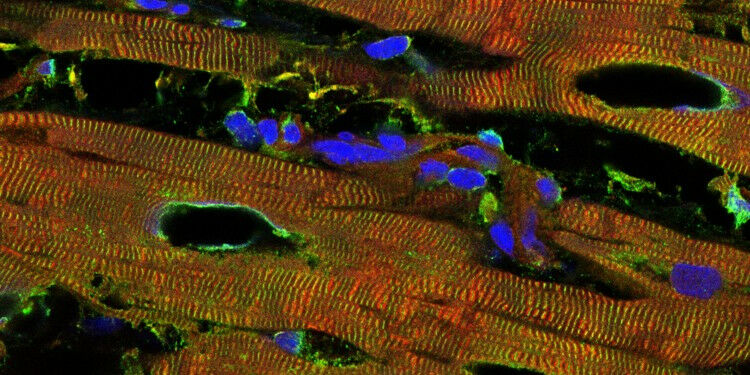
 Heart tissue from a patient with chronic heart disease due to dilated cardiomyopathy. Red staining indicates titin, green another protein of the contractile units, and blue the nuclei. The holes are indicative of disease-induced tissue damage.
Heart tissue from a patient with chronic heart disease due to dilated cardiomyopathy. Red staining indicates titin, green another protein of the contractile units, and blue the nuclei. The holes are indicative of disease-induced tissue damage. AG Linke Titin is a "titanically large" protein - the largest in the human body - which enables elastic movements of our muscles, including the heart. Mutations in the titin gene ( TTN ) that impair this function are the most frequent cause of a heart muscle disease known as dilated cardiomyopathy (DCM), which is characterized by a weak pump function. However, it had not been known why TTN mutations cause the disease, that is, which pathomechanisms underlie DCM. A team of experts headed by Prof. Wolfgang Linke, Director of the Institute of Physiology II at the University of Münster, has gained ground-breaking insights into the pathomechanisms of DCM due to a TTN mutation, which have now been published in the journal Science Translational Medicine .
TO READ THIS ARTICLE, CREATE YOUR ACCOUNT
And extend your reading, free of charge and with no commitment.
Your Benefits
- Access to all content
- Receive newsmails for news and jobs
- Post ads