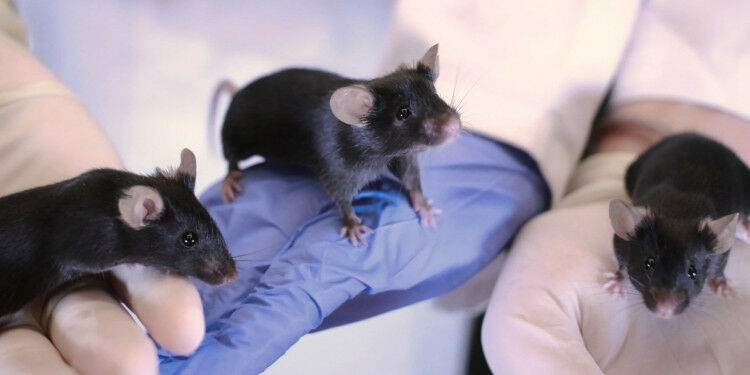
 Genetically identical mice are used in animal research in order to achieve standardised testing conditions.
Genetically identical mice are used in animal research in order to achieve standardised testing conditions. University of Münster - Department of Behavioural Biology - For more than ten years now, scientists have been discussing the so-called reproducibility crisis: often, scientific findings cannot be reproduced at a later time and/or in other laboratories, although the studies are carried out under highly standardised conditions. Thereby, standardisation includes for example the use of genetically identical animals, keeping the animals in identically equipped cages, and carrying out the experiments in always the same way. To uncover sources of poor reproducibility, researchers usually try to identify potential confounding factors in the experimental conditions. Thereby, confounding factor Number One is the experimenter - in other words, the person conducting the experiment. A team headed by behavioural biologists Dr. Vanessa von Kortzfleisch and Prof. Helene Richter from the University of Münster has now studied precisely this factor in behavioural experiments on mice carried out simultaneously at three different locations. Their study has now been published in the journal PLOS Biology.
TO READ THIS ARTICLE, CREATE YOUR ACCOUNT
And extend your reading, free of charge and with no commitment.
Your Benefits
- Access to all content
- Receive newsmails for news and jobs
- Post ads