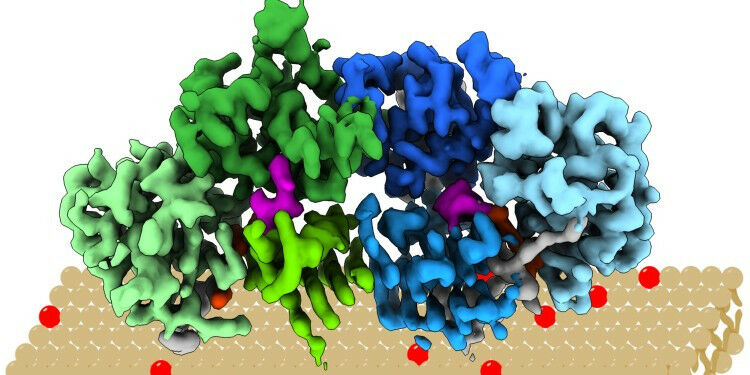
 Model for the docking of Mon1/Ccz1 onto membranes. Ccz1 (green) and Mon1 (blue) form a stable complex with a new type of structure. Positively charged areas on the surface of Mon1 interact with negatively charged lipids (red), and this ensures the correct orientation.
Model for the docking of Mon1/Ccz1 onto membranes. Ccz1 ( green ) and Mon1 ( blue ) form a stable complex with a new type of structure. Positively charged areas on the surface of Mon1 interact with negatively charged lipids ( red ), and this ensures the correct orientation. WWU - AG Kümmel Proteins are indispensable components in living organisms. They are not only "building material" for the body - they also make molecular communication between cells possible, they are needed for nerve impulses to occur, and they control chemical reactions. What is decisive for proteins to function is their three-dimensional structure. If this is known, conclusions can be drawn about how proteins function.
TO READ THIS ARTICLE, CREATE YOUR ACCOUNT
And extend your reading, free of charge and with no commitment.
Your Benefits
- Access to all content
- Receive newsmails for news and jobs
- Post ads