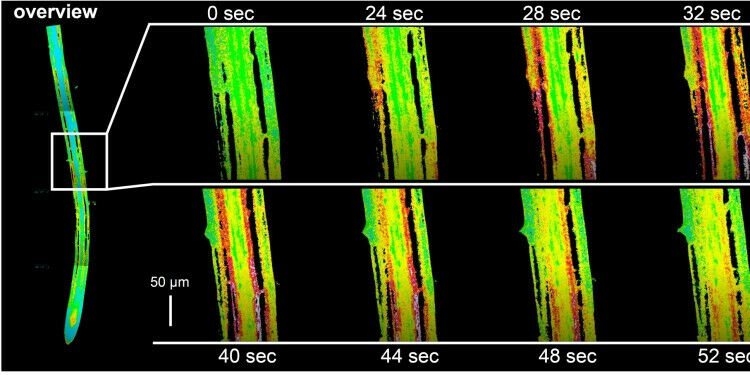
 As an immediate reaction to elevated concentrations of salt (NaCl), the concentration of calcium in the cytosol of a specific group of cells (the sodium-sensing niche) increases within one minute. Shown in false colours: red (highest concentration) > yellow > green > blue.
As an immediate reaction to elevated concentrations of salt (NaCl), the concentration of calcium in the cytosol of a specific group of cells (the sodium-sensing niche) increases within one minute. Shown in false colours: red (highest concentration) > yellow > green > blue. WWU - AG Kudla Biologists at the University of Münster have produced the first description of a calcium signal-controlled switch mechanism for adaptation to varying levels of salt stress / Study published in "Developmental Cell" Unfavourable environmental conditions represent considerable stress for plants. A high level of salt content (sodium chloride, NaCl) in the soil is for example just such a stressor which has a negative impact on plants. Salinization is a serious problem in agriculture especially in dry regions of the world. Biologists at the University of Münster have now discovered, for the first time, that salt stress triggers calcium signals in a special group of cells in plant roots, and that these signals form a "sodium-sensing niche". Also, the researchers identified a calcium-binding protein (CBL8) which contributes to salt tolerance specifically under severe salt stress conditions.
TO READ THIS ARTICLE, CREATE YOUR ACCOUNT
And extend your reading, free of charge and with no commitment.
Your Benefits
- Access to all content
- Receive newsmails for news and jobs
- Post ads