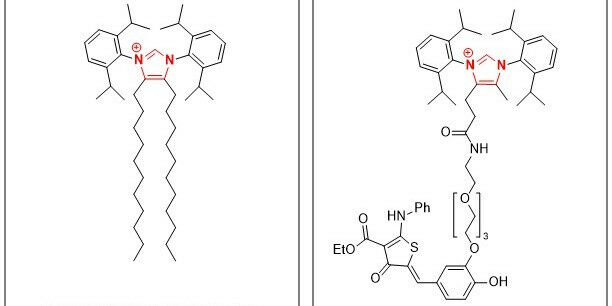
 The Münster team led by Prof. Frank Glorius developed an imidazolium containing molecule that can bind to micro RNAs (left). From this the team of authors around Matt Disney developed a new compound (’RIBOTAC’) that can bind specifically to the micro-RNA of a ’cancer gene’ (MIR155) and dismantle it (right).
Intervention in RNA switches off "cancer genes" / American-German team publishes study in "Nature". The Münster team led by Prof. Frank Glorius developed an imidazolium containing molecule that can bind to micro RNAs ( left ). From this the team of authors around Matt Disney developed a new compound ('RIBOTAC') that can bind specifically to the micro-RNA of a 'cancer gene' (MIR155) and dismantle it ( right ). WWU - AG Frank Glorius If the regulation of cell growth and division gets out of control, cancer is a possible consequence. The gene "MYC", for example, plays an important role in controlling cell growth in humans. If it no longer functions properly, cells grow uncontrollably. This is why this growth-promoting gene is also called the "cancer gene".
TO READ THIS ARTICLE, CREATE YOUR ACCOUNT
And extend your reading, free of charge and with no commitment.
Your Benefits
- Access to all content
- Receive newsmails for news and jobs
- Post ads