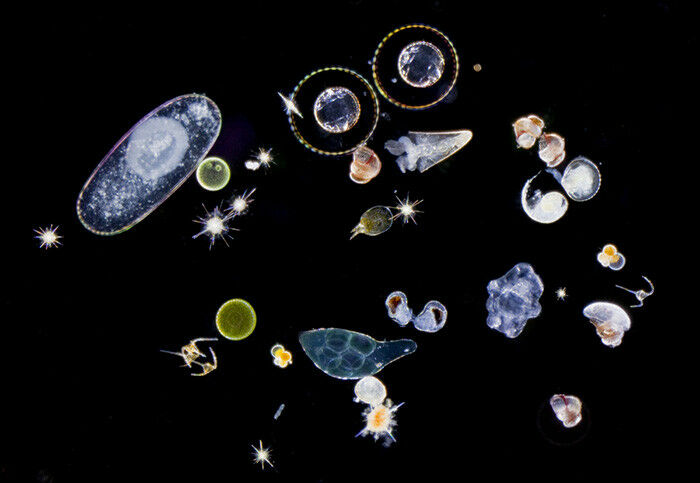
 Planktonic protists and larvae. Plankton collected during the Tara Expedition.
Planktonic protists and larvae. Plankton collected during the Tara Expedition. Christian SARDET / Tara Océans / Plankton Chronicles / CNRS Images A team from the CEA and CNRS have discovered the existence of mirusviruses: a major group of viruses abundant on the surface of the seas and oceans, where they infect single-celled plankton. These findings appear in Nature on 19 April. The discovery provides a better understanding of the scope of ocean biodiversity and the importance of viruses in these ecosystems. Above all, these viruses have an amazing evolutionary history similar to that of the herpes virus, which infects half of the world's human population, and of giant viruses, a completely distinct virus group also abundant in oceans. They offer the scientific community new opportunities to study - in oceans and beyond - the ecology and evolution of DNA viruses. Research was conducted at Genoscope using data collected during the Tara Oceans expedition (2009-2013), a joint endeavour between the Tara Oceans Foundation and in particular teams from CNRS, EMBL and the CEA in the framework of the Tara Oceans consortium.
TO READ THIS ARTICLE, CREATE YOUR ACCOUNT
And extend your reading, free of charge and with no commitment.
Your Benefits
- Access to all content
- Receive newsmails for news and jobs
- Post ads