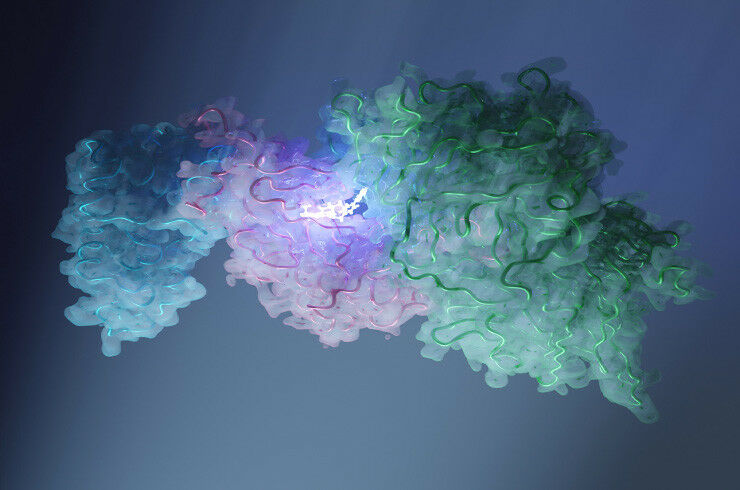
A molecular glue (in white) brings together two cell cycle regulators (purple and blue) with an enzyme (green) that tags them as waste. Image credit: Georg Kempf/Thomä lab/FMI
A molecular glue (in white) brings together two cell cycle regulators (purple and blue) with an enzyme ( green ) that tags them as waste. Image credit: Georg Kempf/Thomä lab/FMI - Despite leaving behind thousands of deformed infants, thalidomide — and newer drugs derived from it — have proved effective cancer treatments. Researchers in the group of Nicolas Thomä at the FMI provided key insights into the mechanism of action of thalidomide-like drugs. Their work could help develop molecules that target and destroy disease-causing proteins, thus enabling the treatment of uncurable conditions. In 1961, Australian doctor William McBride wrote a letter to The Lancet voicing concern about "severe abnormalities" — including shortened limbs, malformed hands and damaged internal organs — in babies born from women who had taken a drug called thalidomide during pregnancy. McBride's concerns about thalidomide, which was being used in dozens of countries for treating morning sickness in pregnant women, were soon confirmed by other doctors in Europe. The drug was banned in winter 1961, but by that point it had affected thousands of babies.
TO READ THIS ARTICLE, CREATE YOUR ACCOUNT
And extend your reading, free of charge and with no commitment.